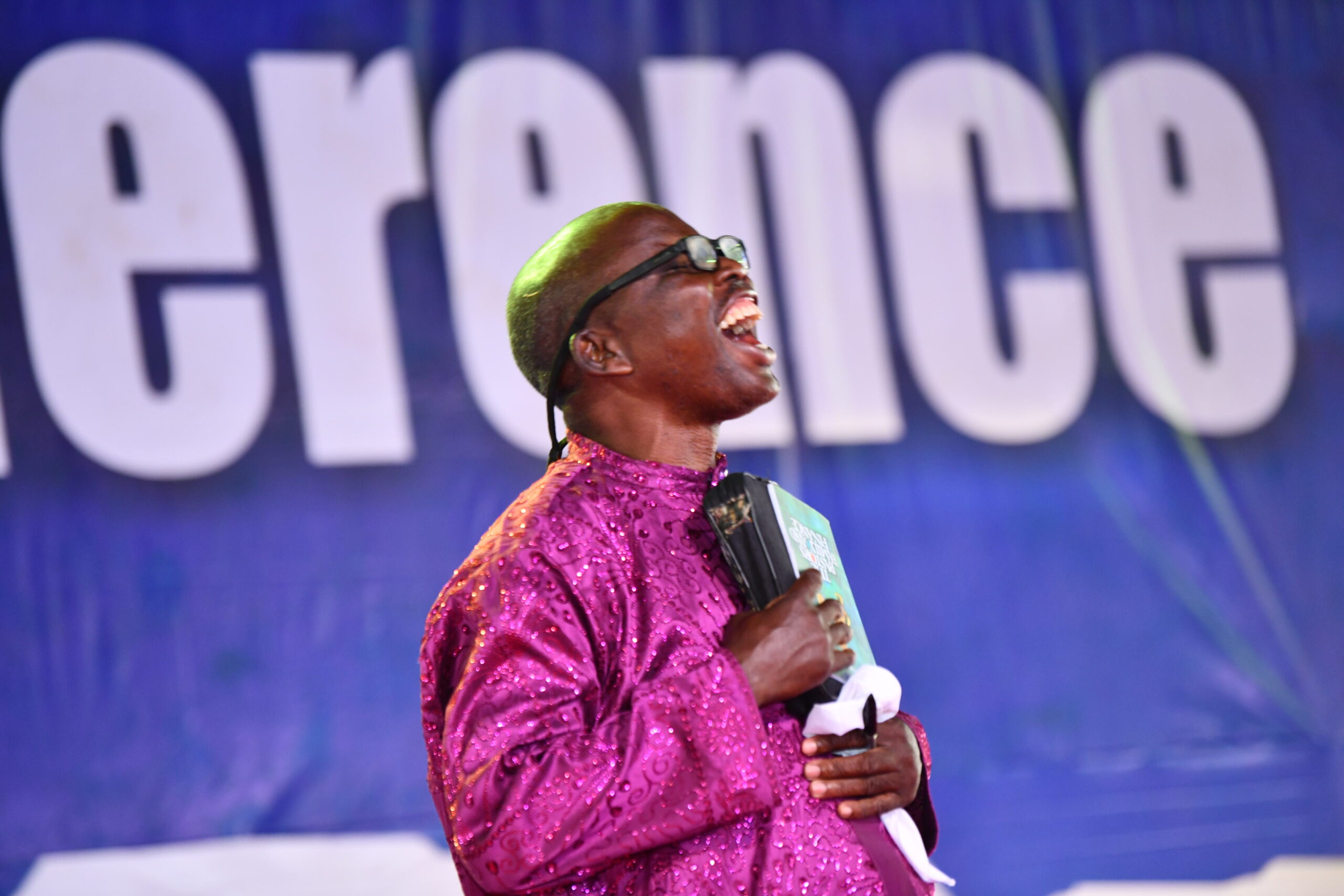

I am your friend, Dr. Charles Apoki. I am here with Barrister Harrison.
Dr. Apoki: Okay. Barrister Harrison. Where are we?
Barrister Harrison: We are in Abakaliki, in Ebonyi State.
Dr. Apoki: Quite a distance from home.
Barrister Harrison: Yes, sir.
Dr. Apoki: But it is a beautiful place.
Barrister Harrison: Yes, sir. Very beautiful.
I came here a long time ago. I used to pass through this place when I was travelling then. At that time, you had a governor who was living in Enugu and he was the governor of this state. It was a newly created state. I used to pass here on my way to Ikom, Boki, Obudu, and even down to the Cameroon border.
It is a very beautiful place. Beautiful natural scenery, an abundance of food, and very nice people. I am also impressed with what your former governor did here. He constructed a lot of flyovers and roads. I just hope they will continue to maintain them.
So what brought me here?
Barrister Harrison: We had the 10th Anniversary of the Advanced 360 Conference. You were invited as one of the keynote speakers to the event.
Dr. Apoki: What is the Advanced 360 Conference?
Barrister Harrison: Advanced 360 Conference, just like the name implies, is about a holistic transformation perspective. We want to address the physical point, which is the outward man, the inner man, and the spirit of the man.
Dr. Apoki: Wow. You must be a pastor.
Barrister Harrison: Yes, sir.
Dr. Apoki: Where do you pastor?
Barrister Harrison: Dominion City Church.
Dr. Apoki: Some people don’t like me. They say I speak against the church.
Barrister Harrison: Oh wow. Is that true?
Dr. Apoki: No, no.
Barrister Harrison: I like your blend, sir. That’s why I follow you closely.
So you are also into real estate.
Dr. Apoki: Yes. How did you get into real estate?
Barrister Harrison: It was not something I planned to do. I grew up in real estate. My father was a land surveyor for over 50 years. He started as one and had a company, Miko Builders Company Limited.
Though it was not something he studied professionally, he somehow learned construction and started building for people. It became easy for him to encourage three of my brothers to go into architecture, another into engineering, and one of us into surveying and quantity surveying.
From secondary school days, we followed him to work. We would carry beacons, go into the bush, and take measurements. From that time, I developed a flair for real estate.
Even though I did not know much about it then, we learned things like the four phases of a beacon point, how to read land boundaries, and later how to handle GPS and surveying tools.
When I went to study law, it became easier for me to major in property law. When I graduated, my father carried all of us along in the business.
If somebody invited him to survey land, he would immediately call me to prepare the landed documents. He would do the survey. Another brother would draw the architectural design. The engineer among us would supervise the building project.
So the whole thing revolved around the family. It was like a Jewish family system where everyone contributed to the same enterprise.
Dr. Apoki: That is interesting.
Barrister Harrison: Yes, sir. All of us are into property.
Dr. Apoki: I hope your wife’s mother is not an architect.
This is very interesting, sir. I am amazed that a Nigerian family can have such a multifaceted professional structure, yet focus on one industry and distribute wealth within the family.
So what is the name of your company?
Barrister Harrison: Big Real Properties.
Dr. Apoki: Big Real Properties?
Barrister Harrison: Yes, sir.
Dr. Apoki: And you sell properties?
Barrister Harrison: Yes, sir.
Dr. Apoki: Land and buildings?
Barrister Harrison: Yes, sir.
Dr. Apoki: People often have the perception that there is no money in real estate in Ebonyi State. So how are you coping?
Barrister Harrison: Well, so far we are the only indigenous real estate company still operating here. Others have exited, and some are planning to exit because of that same perception.
But I have come to realise something: we own the city.
I cannot sell what I do not love. I love this city. Maybe because I am from here, I see it differently from others. We project the city. We promote the good things happening here.
I teach my team that we must love the city enough to see the good in it. Only then can we sell it effectively. That perspective has helped us succeed.
Dr. Apoki: You have to see the good in the city.
Barrister Harrison: Yes, sir.
Dr. Apoki: Love the city.
Barrister Harrison: Yes, sir. Pray for the good of the city. If you are willing and obedient, you will eat the good of the land.
Dr. Apoki: Wow.
I have some very good friends from this place. I have been here to speak in one or two churches before, and I am amazed at the transformation. It is quite a peaceful place.
Barrister Harrison: Yes, sir.
Dr. Apoki: So how was the impact of the conference? I was speaking and you were observing.
Barrister Harrison: On a personal level, I was challenged to do more. I was challenged to see future prospects. If I was thinking of ten, I should now think of one hundred in progression.
I was particularly touched by the story of how you began and the multiplication principle you shared. You said that you are not emotionally attached to any property.
At a certain stage, you can sell and acquire something bigger. At another stage, you can sell a portion and still go for something bigger. When the property appreciates, it keeps moving upward.
Dr. Apoki: Yes. And there is the law of repetition. If you do something and it works, repeat it. If it works, keep repeating it while improving and diversifying over time.
Real estate requires integrity, due diligence, and cash flow.
When somebody buys property, it is not a gift to you. It is an investment. You got that money because you invested. When you want to reinvest, property prices will likely go up.
So when you get money from real estate, be frugal. Respect that money as an entity. Try to have another source of income.
There is a saying: “Monkey go chop the sweet when it dry.” Property will appreciate eventually, but what will you eat before it appreciates?
You must have another business that produces regular cash flow. Otherwise, you may become stranded.
You might have many properties for sale, but if there is a glut in the market, people might not buy. Meanwhile, you still have school fees and family responsibilities. That is when people make distress sales.
So it is wise to maintain another stream of income. Those regular incomes might not be huge, but they are sustainable.
For example, in the legal profession, writing deeds and handling documentation can bring steady small income until the big property deals come.
Barrister Harrison: Yes, sir.
There was also a statement you made that stayed with me: “Do it afraid.” You said we must conquer fear, but you also said you can do something even when you are afraid.
Dr. Apoki: Yes. Courage is not the absence of fear. Courage is the ability to challenge your fears to achieve your objectives.
For me, apprehension leads to preparation. When I feel apprehensive, it makes me take precautions. It makes me prepare more. It is like shifting to another gear that helps you jump the fence.
There is also a kind of intellectual stimulus that comes from conquering fear. Once I conquer a particular fear, I do not fear it again.
And remember, there are hundreds of “fear not” statements in the Bible. Fear is an emotion. The refusal to fear is a decision. The action to confront what you fear is faith.
Something happened many years ago that strengthened my resolve. At one point, I had two parents who were paralysed. One had a spinal cord injury and the other had a stroke.
At the same time, I had two children with medical challenges. One had bilateral genu valgum (bowed legs), and another had cleft lip and palate.
Then my landlord asked me to pack out of the house. I was about 31 or 32 years old, alone in the East, and I had not seen my elder brothers for years. I was deeply troubled.
Then God showed me something. I saw Saddam Hussein on television, parading confidently. God spoke to my heart: “That man does not know Me and does not have Jesus Christ, yet he is parading boldly. Why are you afraid when you have Me?”
That strengthened me.
Later, my wife and I used to pray. We would say, “When we finish buying a car, we will build a bungalow.” I would say amen.
One day, while travelling, I saw my wife’s grandfather’s storey building, built in the 1920s. That man did not go to school. He was not a pastor or a medical doctor. Yet he built that house.
As I crossed the bridge that day, I told my wife:
“All the amen I agreed with you before, I withdraw them. If your grandfather could build a storey building, I will build a storey building first before buying a car.”
And interestingly, the day we were decking the building was the same day we bought another car.
Most of the things I have achieved in life were done without having everything ready first.
I did not have my admission letter before going to the university. I went there and got admission later.
When I wanted to marry, I had ₦54 in my account. At that time, the naira was strong against the dollar. Yet I still went ahead and got married.
Life has never been easy for me, but once I take a decision, I move forward.
People talk about stress and mental health, and those things are real. But sometimes, poverty itself can worsen mental health.
It is better to pursue your purpose with courage. Fear has always been part of the human experience.
I always tell my wife: a king is someone who confronts fears that others in the community are afraid to face.
So the conquest of fear is one of the prerequisites for success in life.
And remember something important:
Even the person you are afraid of is also afraid of something.


